Film

All posts in the Film category

Hopelessly Devoted to: Gloria DeHaven!

Published March 11, 2015 by biggayhorrorfan

DeHaven & Thompson

DeHaven & Thompson

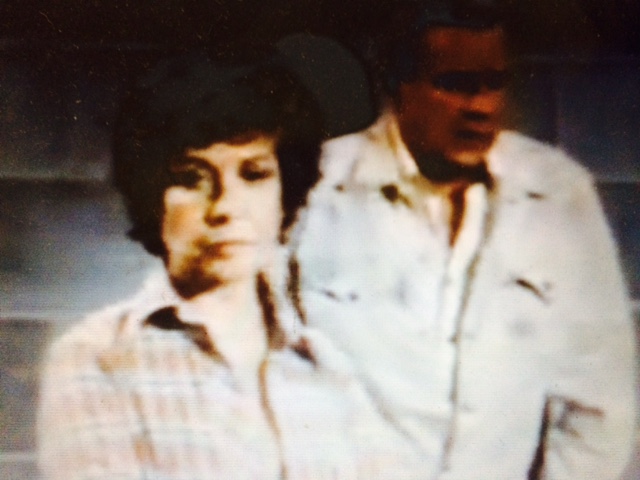
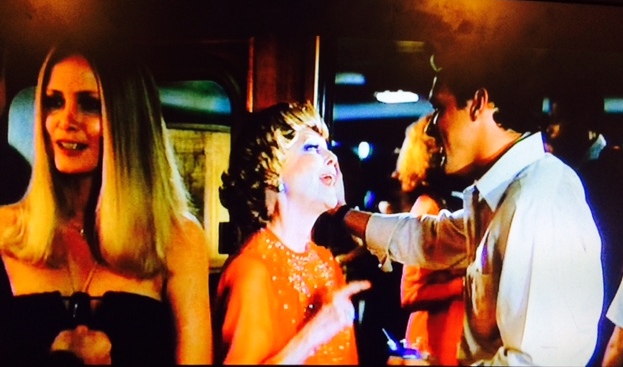
Filmed in Harshaw, Wisconsin in 1978 (but not seeing the light of day until the early 1980s), Bog allows Hollywood musical royalty Gloria DeHaven (whom appeared in Step Lively with Frank Sinatra and played her own entertainer mother, Flora Parker DeHaven, in Three Little Words) to add a true (‘n truly goofy) monster flick to her aged coterie of television dramas, soap operas and afternoon hosting appearances.

In her dual roles, hyphenate Ginny Glenn (described as a coroner, pathologist and biologist by various sources from within the film) and ageless woods hag Adrianna, DeHaven simply and authoritatively illiterates scientific jargon as the former and adds a sense of mysterious menace as the former. Still lushly attractive at 53, the flaming haired singer grounds the film’s outrageous occurrences with quiet dignity and honesty. A bit of Hollywood posing does leak in when Ginny’s romance with the local sawbones (Marshall Thompson – late of It! The Terror From Beyond) reaches its peak and as she Fay Wray’s it in the fish-beast’s arms during the final moments, but as a whole DeHaven is restrained and powerful never sinking to ‘how did my career come to this?’ pathos.bog
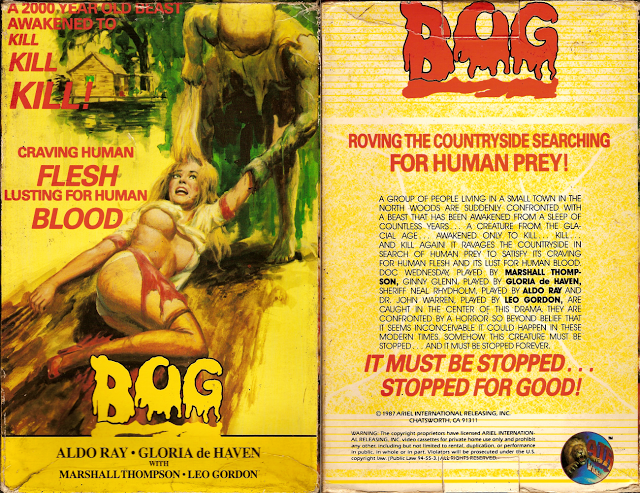
DeHaven’s thankful subtlety grounds the film itself, which concerns a (supposedly) prehistoric sea creature brought to the surface of a small country town by illegal dynamite fishing, with a professionalism and sense of fun that allows the audience, fully, into the proceedings. Filmed almost documentary-style (like many 1970s swampland creature features such as Creature from Black Lake and Return to Boggy Creek with Dawn Wells from Gilligan’s Island) by director Don Keeslar (whom obviously embraced the outdoors – his only other directing credit is The Capture of Grizzly Adams), Bog, also, serves as a historical document – allowing one to experience small town life circa the late 70s as many locals, both professional (such as Carol Terry, of low budget cult film god Ted V. Mikels’ The Doll Squad) and not, are used in the proceedings).

In fact, the vicious creature is enacted by a 6’7”, 247 pound resident, Thomas “Jeff” Schwad. Of course, Schwad’s creature, when fully revealed, looks like a flapping, winged Creature of the Black Lagoon prototype with a massive fish for a head – making it one of the most hysterical and oddly memorable creatures of the mutant beast genre. Designed as part ecological statement (don’t blow up the fishies!) and part horny aberration (the creature survives on the blood of women and somehow, utilizes them to conjure up a boatload of fertilized, ocean bottom caviar), Bog is outrageous, choppily edited and a wonderful document of the drive-in cinema of its time. In between its bouts of monster mania, it is, also, as laid back and slow going as a long country day in the summer. If said day included a comical shot of a deputy’s hand, sinking into the drink, a la Excalibur, with a wrinkled fish’s mouth wrapped around his elbow, that is!
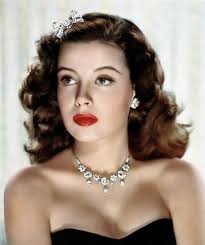
Classic DeHaven!

Classic DeHaven!


Until the next time – SWEET love and pink GRUE, Big Gay Horror Fan!
http://www.facebook.com/biggayhorrorfan

Hopelessly Devoted to: Vivian Blaine!

Published March 5, 2015 by biggayhorrorfan

Blaine in The Dark

Blaine in The Dark


Glamorous redhead Vivian Blaine (1921 – 1995) entered the world of cinema as a musical performer in the 1940s. As her roles in films such as State Fair and Doll Face (with Carmen Miranda) began to dry up, she returned to the Broadway stage and created the role she is best known for, Ms. Adelaide, in the original Guys and Dolls in 1950. (This is a role she, also, winningly recreated for the film version in 1955 with Marlon Brando.) Television roles followed and, in the late 70s and early 80s, she added some class to two mutated, pore sucking opuses that earn her a secure and beloved place in monster movie hall of fame.

The Dark. 1979. Blaine’s Role: Courtney Floyd.

Don’t you just hate it when the local whores and random passers-by start getting ripped apart by a giant space creature in dank alleys? Well, so does The Dark’s master crime writer (played with flippant charm by William Devane) – especially when the first victim is his daughter (played, interestingly enough, by the soon-to-be Kathy Hilton). Aided by a television reporter, portrayed by Cathy Lee Crosby (a participant in 1973’s The Laughing Detective, a Walter Matthau film whose gay killer scenario has definite pre-shades of William Freidkin’s controversial Cruising), and a shaggy forensic master (radio announcer and Scooby Doo wonder Casey Kasem), Devane soon discovers a party psychic (turned true clairvoyant) may have clues to the vicious killings.

As a link to the previously fake wonder, Blaine’s Floyd, is frisky and fun. Her brief scene with Devane vibrates with husky sexuality and one almost believes Blaine could have a chance with the much younger Devane, such is her breezy confidence. (Of course, since Blaine is playing an actor’s agent, she probably had plenty of personal acquaintances and situations to draw from.)

with Devane

with Devane


As for the film itself, The Dark is a frequently tense (especially in its twisted opening scene featuring a possibly psychotic, seemingly blind man following a frightened woman down a jagged path) and gloriously cheesy. (Besides its massive paws with claws, the creature also shoots laser beams from its eyes). Unfortunately, the film loses steam during its final act and its ending is far too abrupt to be anywhere as satisfying as the film’s first half. Although, The Dark does have some high profile fans including Scott Spiegel, the writer of Evil Dead 2.

Parasite. 1982. Blaine’s Role: Miss Daley.

Best known as the vehicle that gave Demi Moore her first starring role, the producers of this Italian Stallion knew who their true star was – Blaine is introduced as Miss Vivian Blaine in the opening credits of this, her second to last film.

Concerned with a nervous scientist, hunted by the ruling Marshalls in a post apocalyptic world, Blaine is Miss Daley, queen of a crumbling boarding house. Of course, our timid chemist arrives at Daley’s dusty rooms with more than rent in tow. Having created a deadly parasite, he is desperately searching for a cure. When one of the chewy fiends is loosed upon a violent gang of teens, though, hell soon erupts in dry town.viv blaine parasite

In a nice touch, Blaine’s Daley is revealed as a former actress. This character devise is never discussed, though. Subtly (especially for this type of film), all is revealed through the photos hanging on the walls of her dilapidated estate. Blaine plays fully into the action when one of the infected teens is brought to Daley’s establishment, causing furious demises for many. With a touch of bitterness and wit, Blaine reveals Daley as a woman still concerned about her appearance just (spoiler alert) before her core sucking obliteration. Gasping arthritically ‘til the end, Blaine’s expiration is one of the film’s most memorable proving, once and for all, if you’re going to be in one of these demented babies, dying well is the best revenge.

On DVD, Parasite’s 3D origins are apparent with its main creature (and title card) popping into your face in an obvious manner. That the creature looks as much like a deranged Muppet with tremulous fangs as anything else is among its extreme goofy pleasures.

In a poignant note, actor Tom Villard (We’ve Got it Made, Popcorn) who, sadly, died of AIDS in 1994, gives an enthusiast performance as one of the creature’s first hollowed out victims. Cherie Currie (lead singer of The Runaways and the doomed vixen of Foxes), also makes a dewy appearance making this gastronomical romp a true cult film through actor appearances alone. (Devotedly, Blaine was one of the first celebrities to devote herself to raising awareness and money for AIDS charities.)

viv blaineIn an interesting note, Blaine’s last appearance was on an episode of the first season of Murder She Wrote (1985) called Broadway Malady, playing Lorna Luft’s mother. Here Blaine gets to sing in a full out production number and fight off an extremely lethal death by gas stove while Luft’s vocal pyrotechnics are matched by her character’s injury in a fairly blunt and violent shooting sequence orchestrated by character actor Gregg Henry (Slither, Just Before Dawn, Body Double).

Until the next time – SWEET love and pink GRUE, Big Gay Horror Fan!

http://www.facebook.com/biggayhorrorfan

Review: Tales of Poe

Published March 4, 2015 by biggayhorrorfan

Tales+of+Poe+Poster
Maverick in its accomplishments, the anthology Tales of Poe is the perfect example of independent terror filmmaking at its most inventive.

Collaborators Alan Rowe Kelly and Bart Mastronardi have mixed old school 50s Gothicism with a distinctively modern spin on two of Poe’s best known tales and one poem here, with intense visuals and some truly superb performances highlighting the affair, as a whole.

In particular, Kelly’s imperial Gogo in The Cask, the second installment, is a marvel of femme majesty. Channeling such vixens as Faith Domergue, Angela Lansbury (who played a couple of wicked noir style villainesses in the 40s) and Joan Bennett, Kelly also adds his own ticks and quirks to this stunning creation, one of the most enjoyable antagonists in recent history.

Kelly is well supported by the surprisingly good Randy Jones (of Village People fame). Playing Gogo’s wealthy, newlywed husband Fortunato, Jones is entirely convincing and completely sympathetic as he discovers that his new spouse has some very poisonous remodeling plans, on their wedding night, no less.Gogo

Just like The Tell Tale Heart, the film’s fine, bloody first segment (https://biggayhorrorfan.wordpress.com/2014/08/25/review-the-tell-tale-heart/), The Cask doesn’t skimp on the gruesomeness. If there is one minor flaw it’s that, unlike Tell Tale’s uniformly excellent minor and supporting performances, including David Marancik’s believably unstable Fritz, not all of the performances of Fortunato’s rich acquaintances are quite believable here, with a couple of the performers either delivering too little or too much.

The final piece truly reveals the ingenuity of Mastronardi and Kelly, though. Full of stunning images and fun performances by such genre goddesses as Adrienne King and Caroline Williams, Dreams, a take on a Poe verse, seemingly follows a young woman on her adventures as she hovers between life and death.

Taking up almost a full third of the film’s running time, this (mostly) dialogue-less, stream of conscious segment, may be a bit too much for folks longing for the linear delights of the first two pieces. But illuminated by Amy Steel’s truly wondrous voiceover work and performance as a grieving mother, this portion of the film truly illustrates the risk taking delights of this project, as a whole.

Keep up with Tales of Poe as it engrains itself further into the terror consciousness at https://www.facebook.com/pages/Tales-of-Poe and http://www.talesofpoefilm.com.

Until the next time – SWEET love and pink GRUE, Big Gay Horror Fan!

http://www.facebook.com/biggayhorrorfan

Music to Make Horror Movies By: Jack Off Jill

Published March 1, 2015 by biggayhorrorfan

jack off jill
Considered the female fronted equivalent of Marilyn Manson, Fort Lauderdale goth rockers Jack Off Jill, guided for its eight years of existence by the glorious Jessicka (Addams) and Robin Moulder, should have shelf space in every terror loving freak’s audio palace.

That their brilliant track Rabiteen runs over the closing credits of the disturbing 1998 exploitation offering Wicked, which floated in limbo until Julia Stiles’ bankability allowed it a release in 2001, should definitely earn them some further genre respect, as well.

Despite a breakup in 2000, the band still has an website available at http://www.jackoffjill.com.

wicked

Until the next time, SWEET love and pink GRUE, Big Gay Horror Fan!

http://www.facebook.com/biggayhorrorfan

Congrats, Carla!

Published February 28, 2015 by biggayhorrorfan

carla
“Give me a sense of purpose, a real sense of purpose, now!” – The Pretenders/Chrissie Hynde

This isn’t trending like a white or gold (or is it blue?) dress (really Facebook?!?), but the Academy of Arts and Sciences did give the grand Carla Laemmle (1909-2014) some post-Oscars memoriam recognition for her contribution to motion pictures.

http://oscar.go.com/photos/2015-oscars-in-memoriam/media/laemmle_carla_actress

As one of the premium members of Universal’s film dynasty, Carla appeared in Lon Chaney’s classic silent The Phantom of the Opera and spoke the first lines in the beloved Dracula, featuring the one and only Bela Lugosi.

Since her death this fall, Laemmle’s family has, frequently, updated her fan page with new photos and interviews.

If you’re ever in the mood for old school Hollywood glamour, check it out at:

https://www.facebook.com/carlalaemmleactress

Until the next time – SWEET love and pink GRUE, Big Gay Horror Fan!

http://www.facebook.com/biggayhorrorfan

Hopelessly Devoted to: Lynn Bari!

Published February 27, 2015 by biggayhorrorfan

LynnBari001-794589
With her patrician curls, sophisticated kewpie features and a distinctive, oceanic voice calmed by smoked whisky undertones, Southern bred Lynn Bari (1913-1989) dominated B-movies (and the occasional major feature such as Blood and Sand) from the 1930’s until the early 1960’s. Often cast as a seductress, Bari could play noble just as efficiently, and two of her starring mid-period roles found her tangling with the king of fright, on one hand, and an exotic heartthrob, on the other.

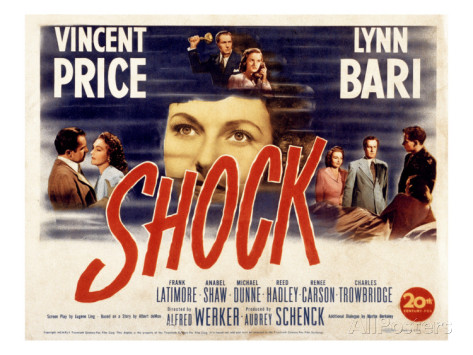
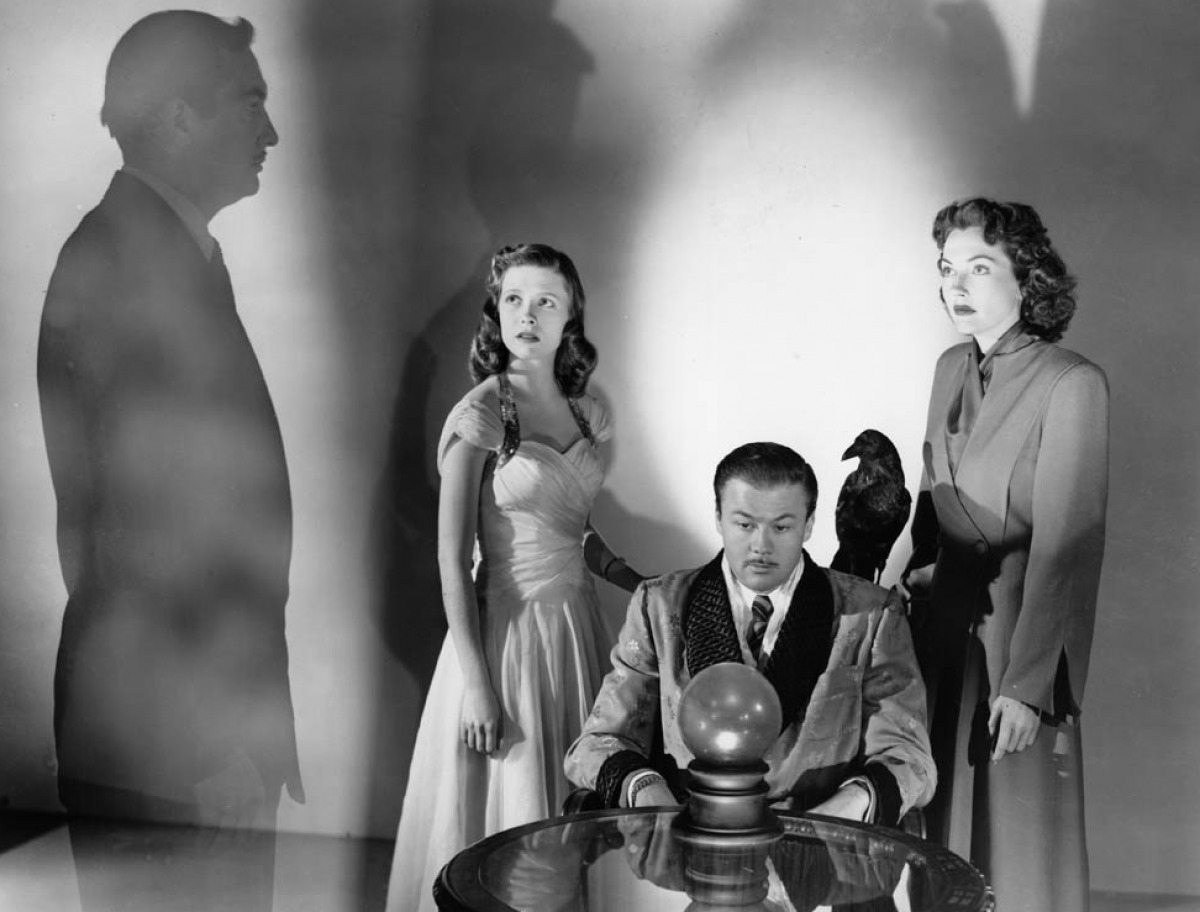
Shock. 1946. A young war bride witnesses a psychiatrist’s (played by Lord of the Goth, Vincent Price) crime of passion against his much older wife and in a state of mute horror, soon finds herself trapped at the asylum that he runs.shock

There, Price’s character struggles with his conscience, as he tries to deal with covering up his murderous rampage while simultaneously caring for the welfare of his young victim. Fortunately, (or unfortunately, as the case may truly be) Nurse Elaine Jordan, his lover, played with clipped control by Bari, has no such sympathies and as twists in the case arise, she becomes determined to rid the world of the one person with any knowledge of her paramour’s wrongdoing.

Filmed briskly by director Alfred L. Werker, Shock’s one true moment of camera-action beauty occurs as a frantic Bari runs across the wind tossed estate of the medical facility to Price’s quarters. The buildings and alleyways loom ominously as Bari sprints, majestically, to her destination and there is more tension in this short sequence than in the majority of the film’s other twisted occurrences.

Pedestrian, yet fun, Shock’s title, ultimately, refers not only to the young married’s initial response to Price’s act but also to the malevolent death Bari prescribes for her – a slow death by insulin shock poisoning.

The Amazing Mr. X. 1948. Here, as regal widow Christine Faber, Bari is the unwitting victim. Walking along a rocky seascape near her house one evening, Faber is surprised by the handsome Mr. X, aka Alexis, (European stud Turhan Bey) whom possesses intimate knowledge of the details of her life.The_Amazing_Mr__X_(1948)_1

A supposed clairvoyant, Mr. X soon has Faber and her young, live-in sister, wrapped up in his mystical palms. Despite eventual evidence of X’s underhandedness, Faber still goes through with a séance to contact her deceased husband – where things ultimately begin to unravel in a deadly manner.

Silkily proud, Bari’s Faber is a strong, yet vulnerable woman and the moody, fog ridden cinematography (masterfully composed by John Alton) not only creates a sense of beautiful tension for the feature itself, but drapes Bari’s elegant features with a misty, haunted precision as well.

Containing several outright shocks (especially during the film’s final reel), director Bernard Vorhaus brings out more in the film’s modest budget than would be expected, making The Amazing Mr. X, a step above normal B movie fare – eventually exposing itself as a proud achievement for Bari.

Until the next time – SWEET love and pink GRUE, Big Gay Horror Fan!
http://www.facebook.com/biggayhorrorfan

Move Over, Bessie! This is the BLOODY Barn!

Published February 26, 2015 by biggayhorrorfan

barn
I grew up in the country, so I know the wickedness of barns – kicking horses, smelly cows, haylofts you can’t escape from once you’ve climbed into them…

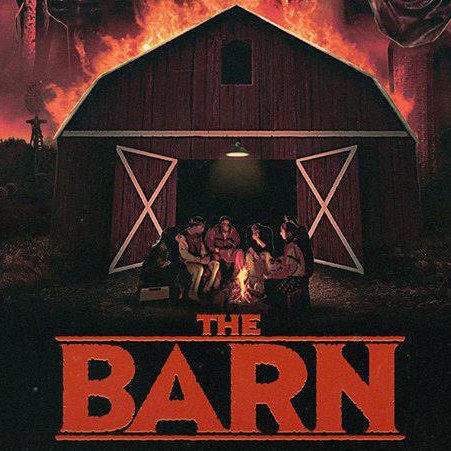
Now, the brilliant Nevermore Productions takes that terror and multiplies it, slasher-style, with their juicy looking throwback titled, naturally, The Barn!

They’ve just released their first official trailer for the piece:

…and you can follow all of this project’s bloody straw bound magic at:

http://www.facebook.com/TheBarnmovie and

http://www.nevermoreproductionfilms.com, as well.

Until the next time – SWEET love and pink GRUE, Big Gay Horror Fan!

http://www.facebook.com/biggayhorrorfan

Review: Strangers in the Night (1944)

Published February 25, 2015 by biggayhorrorfan

strangers in the night cover
While the 30s and 40s were dominated by the villainous portrayals of Bela Lugosi, Boris Karloff, Peter Lorre, Lon Chaney, Jr., Basil Rathbone, John Carradine, Lionel Atwill and others, occasionally a strong female antagonist would peek out from behind the blood stained curtains. While Dracula’s Daughter (1936) and Captive Wild Woman (1944) are prime examples of this, Republic Pictures’ little known Strangers in the Night (1944), released on Blu-Ray by Olive Films in 2013, features both a very strong female lead and a truly disturbing dowager femme at the heart of this shadowy production’s mysterious and deadly doings.

Sgt. Johnny Meadows, an injured marine, travels to a small seaside town to meet his female pen pal. Though they have never met, the two have fallen in love and are destined to marry. Of course, Johnny happens to encounter Leslie, the town’s beautiful young doctor, on the train ride in and his attraction to her, coupled with the fact that his never seen sweetheart is mysteriously missing, soon has him switching his affections. Of course, Hilda, his pen pal’s mother, who keeps on insisting her daughter will arrive shortly, is not too happy with this. Seemingly possessed by the enormous living room portrait of her daughter, Hilda eventually succumbs to her darker impulses and it seems, no one, not even her devoted companion Ivy, will escape from her homicidal wraith.

Thimig, Grey and Barrett.

Thimig, Grey and Barrett.


As this film whispers with shades of such classics as Rebecca (1940) and Laura (1944), director Anthony Mann and cinematographer Reggie Lanning nicely fill it with moody noir lighting and establish Hilda’s cliff top mansion as a haunting presence unto itself. Their work is truly exemplified, though, by the fine portrayals of Virginia Grey, as Leslie, and Helen Thimig, who truly radiates with a glowering sense of madness as Hilda. With simple majesty, Thimig makes this proud woman, crippled both emotionally and physically, one of the most intense presences of those early exploitation years.

Granted, the mystery surrounding Hilda’s daughter can only be resolved in a number of ways, yet the trio of writers (Philip MacDonald, Bryant Ford, Paul Gangelin) do surprise those expecting a more deadly offering with their resolution. They, nicely, also give Grey’s Leslie plenty to do. She is both humble, recognizing that her position is rare for the time, and determined in her vocation. While annoyed with Hilda’s interference, she is also exceedingly kind. Grey, brightly, handles all these facets and is particularly poignant when discovering that Johnny is, initially, claimed by another.

The lovely Grey, best known to terror freaks for her role opposite cult icon Rondo Hatton in House of Horrors, also, appeared in numerous other cult titles such as Who Killed Doc Robbin and Unknown Island. But, Strangers in the Night, also, contains an interesting, round-about connection to horror via the presence of Edith Barrett. Barrett, who brings a leveled humor and hesitancy to the nervous Ivy, was the first wife of the legendary Vincent Price. According to published reports, in real life, Barrett, an esteemed stage actress, was actually a combination of the jittery Ivy and the deluded Hilda, but here she is quietly luminous, rivaling the performances of Grey and Thimig for attention.

You can find more about the unique offerings from Olive Films at http://www.olivefilms.com and http://www.facebook.com/olivefilms.

Until the next time – SWEET love and pink GRUE, Big Gay Horror Fan!
http://www.facebook.com/biggayhorrorfan

The Destruction of Princess Tilde!

Published February 23, 2015 by biggayhorrorfan

Princess Tilde defying Valentine.

Princess Tilde defying Valentine.


Someone left this cake out in the rain!

Filled with sophisticated, comic style mayhem that is piloted by a handsome, plucky hero (Taron Egerton’s Eggsy), who, in turn, is buoyed up by such distinguished talents as Colin Firth, Michael Caine, Samuel J. Jackson and Mark Hamill as a multitude of engaging mentor types and villains, Kingsman: The Secret Service is loads of glorious fun.

My one issue with the film, besides some truly obvious head bursting moments of CGI action, is the ultimate treatment of Princess Tilde, one of the movie’s strongest female characters, portrayed with quirky resolve by Hanna Alström.

Tilde is one of the few fully featured, distinguished characters who actually rejects the devious plan of the primary villain, Valentine (Jackson), and winds up imprisoned in his underground bunker. Spunky and willful to Valentine’s every overture, she is a steely example of a femme in an action movie.

Yet, co-writers Jane Goldman and Matthew Vaughn (who based their script on the comic book The Secret Service created by Mark Millar and Dave Gibbons) betray this positivity by turning her into a sexual joke by the film’s closing. Upon finally meeting Eggsy, who promises to defeat Valentine, Tilde spontaneously offers up an outrageous sexual favor should he succeed.

This suggestion is so damaging, ultimately, because it is so left field for the defiant princess. Development is, obviously, important for a character and if even, momentarily, Tilde had revealed some kind of amorous side previously, this denouement may have worked. Even more importantly, it is, also, out of context for the film, itself. While there are plenty of spy antics, exaggerated feats of violence and explorations of the darker side of the street thug lifestyle detailed in the film, there is little to no sexuality offered up, making Tilde’s comment stand out all the more.

That our last image of the character is one of her rolling over to, luxuriously, fulfill her promise is, also, unfortunate. Granted, anytime a woman in film (or life, for that matter) expresses a powerful sexuality outside of the vanilla zone is definitely important. Yet, the effect, here, is that moment is all most movie goers will remember about Princess Tilde.

Surely meant as a play on the excessive sheet turning of the Bond films, this issue could have been saved if we saw Tilde reversing the tables on Eggsy by throwing him on his backside to, ultimately, show him what she really meant by “do it in the asshole”.

Sadly, this is not to be.

Until the next time – SWEET love and pink GRUE, Big Gay Horror Fan!
http://www.facebook.com/biggayhorrorfan

Get Scared Gets Shannon!

Published February 14, 2015 by biggayhorrorfan

shannon big
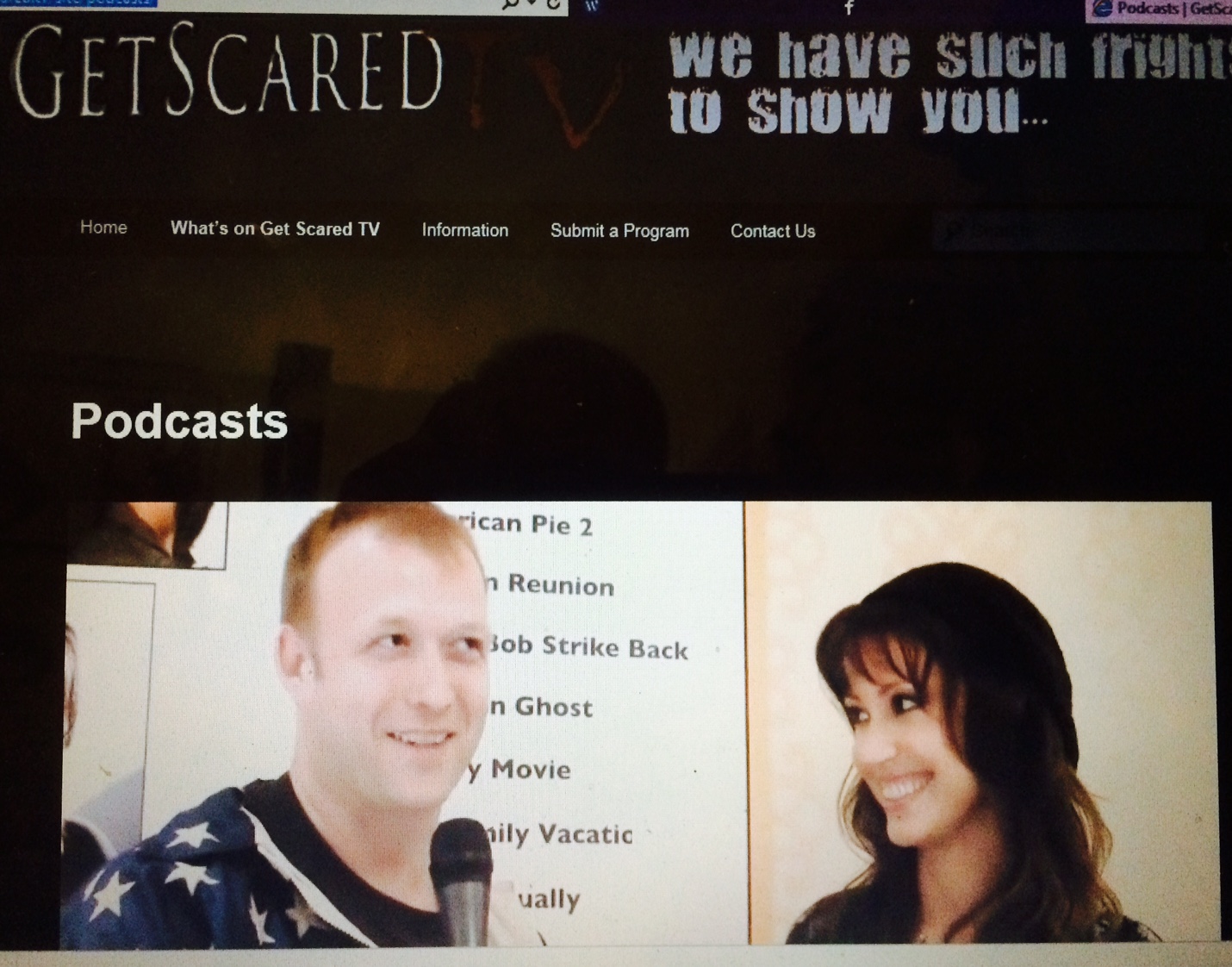
Who needs American Pie when you can stand next to Shannon Elizabeth and ask her a few questions?!?

Yes, Get Scared TV, that rapturously moaning institution of free fright, has uploaded my interview with the swingingly divine Elizabeth (Thirteen Ghosts, Cursed, Night of the Demons) and I… well, I am going giddy with sweeping moments of flashback joy!

You can check out the interview and everything else that this dastardly fun network has in store for you at

http://getscared.tv/site/podcasts/

Until the next time – SWEET love and pink GRUE, Big Gay Horror Fan!
http://www.facebook.com/biggayhorrorfan